What is Automated Processing?
Automated processing is the complete processing of a document- or data-related procedure by a system without manual intervention by employees. All steps, from data entry and verification to the final decision or archiving, are performed automatically in the background without the need for human intervention.
Automated processing is therefore a central component of modern process management and contributes significantly to increasing efficiency in companies. It is the goal of many digitization projects, especially in areas such as customer service, invoice processing, insurance processes, and administrative procedures.
Straight to:
- Why is Automated Processing so important?
- In which areas can fully automated processing be achieved?
- What are the requirements for successful automated processing?
- What technologies are used for automated processing?
- Benefits of Automated Processing
- Automated Processing made easy: NOVO CxP & NOVO AI Studio by inovoo
- Conclusion: Automated Processing is the future
Why is Automated Processing so important?
Many companies and organizations today are under pressure to handle processes faster, more cost-effectively, and with fewer errors — especially when dealing with large volumes of documents. Traditionally, applications, forms, emails, and invoices were first reviewed, evaluated, and manually transferred to specialized systems. This is not only time-consuming, but also prone to errors and difficult to scale.
Automated Processing provides a solution to this: it automates all the tasts that occur from receiving the document or set of data all the way to the final decision. This not only significantly reduces throughput times, but also saves your staff's time and resources, which can then be used to focus on more complex cases.
In which areas can fully automated processing be achieved?
Automated processing is particularly suitable for workflows with a high degree of standardization and clear decision-making rules. In such cases, automated processing can be easily achieved on high level. Typical use cases include:
-
Invoice processing: Incoming invoices are automatically captured, checked, posted, and archived — without manual verification, if all parameters are correct.
-
Customer service: Requests (e.g., address changes, contract terminations) are processed automatically if they contain all the necessary information.
-
Insurance processes: Reports on certain types of claims (e.g., simple motor vehicle damage) can be verified, evaluated, and approved for payment immediately.
- E-government: Forms or applications are automatically checked for completeness, categorized, and forwarded for further processing (e.g., in citizen portals).

What are the requirements for successful automated processing?
Not all types of tasks are suitable for automated processing. Certain requirements must be met for a process to run fully automated in the background:
- Structured and complete input data: The information must be machine-readable and complete — e.g., through prior intelligent data extraction.
- Clear decision logic: Decisions have to be made by defined rules or AI models (e.g., if A, then B).
- Error and exception handling: For unclear or incorrect information, a manual validation option has to be available – meaning it gets sent to a human to handle.
What technologies are used for automated processing?
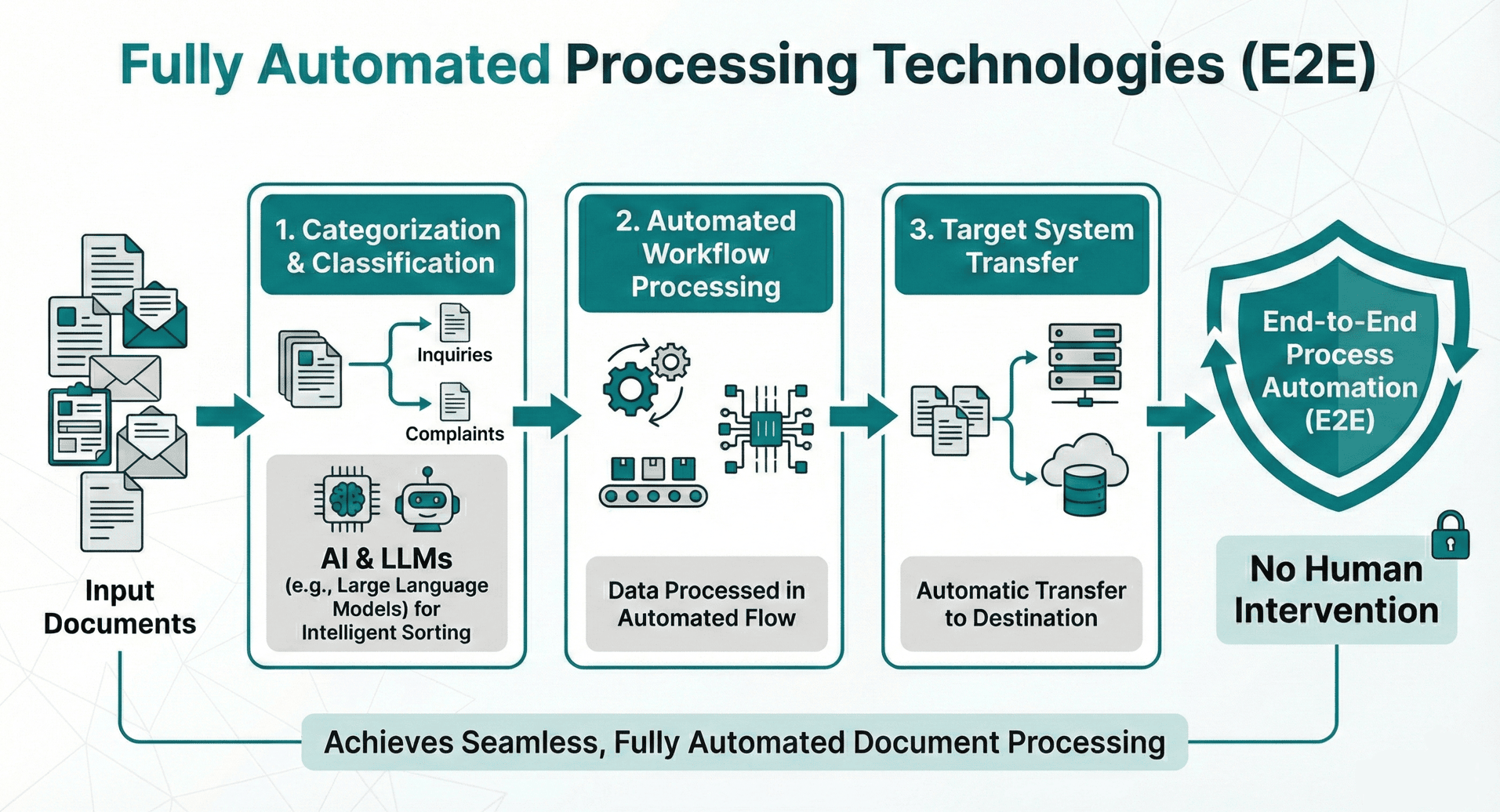
Fully automated processing relies on a mix of technologies and systems. First, the documents have to be sorted into categories (such as inquiries, complaints, etc.). For some use cases, new AI technologies such as LLMs are increasingly being used. After this classification step, the data is processed in an automated workflow and then automatically transferred to the target system. If all these steps are carried out without human intervention, this is referred to as fully automated processing or End-to-End Process Automation.
Benefits of Automated Processing
Fully automated processing offers numerous advantages for businesses:
- Time and cost savings: Eliminating manual tasks increases the efficiency of the entire process. Employees can use the time they save to focus on their core tasks.
- Error reduction: Automated systems work in a standardized and consistent manner — without oversights.
- Scalability: Whether 100 or 10,000 transactions per day – automated processing can easily grow with your business.
- Better customer experience: Shorter response times ensure higher customer satisfaction.
- Traceability: Every step in the process is documented, which makes audits and reviews easier.
- Resource efficiency: Employees can focus on complex cases and other important tasks.
Companies that achieve fully automated processing gain a significant competitive advantage through these benefits.
Automated Processing made easy: NOVO CxP & NOVO AI Studio by inovoo
With NOVO CxP, inovoo offers a modern platform for end-to-end process automation that makes processing data and documents easy and flexible. The platform integrates seamlessly into existing system landscapes and enables transparent control of all processes.
For particularly complex and unstructured input data, we recommend combining it with NOVO AI Studio — an intelligent, LLM-based solution that can extract precise information even from documents that are difficult to interpret.
Conclusion: Automated Processing is the future
Fully automated processing is the highest level of process optimization. Achieving a high automated processing rate not only saves resources, but also increases service quality and competitiveness. With the right solutions (e.g., NOVO CxP and NOVO AI Studio by inovoo), you can bring automated processing to your company. Whether you receive invoices, applications, emails, or damage reports: wherever automated processing is possible, it should be put into practice.
