What is Output Management?
Almost every company generates large amounts of information every day: responses to customer inquiries, invoices, order confirmations, contracts, and much more. This content must reach customers, partners, authorities, or internal departments in the right form, at the right time, and via the appropriate channel. Output management refers to the central control, preparation, and distribution of all documents and data generated in a company. This is not just about printing documents, but rather about providing information via the appropriate channel, including email, portals, EDI, or traditional letters . The goal is to make corporate communications efficient, consistent, and transparent, while optimizing both internal and external communications. Output management ensures that information is not created in isolation in individual systems, but can be controlled centrally and used flexibly.
Go straight to:
Why is Output Management so important?
The problem is that, in many organisations, each department creates its own documents with individual layouts and on different output channels. The result? Inconsistent customer communication and enormous maintenance costs. Every change to templates or legal requirements must be implemented dozens of times, which is error-prone, time-consuming and expensive.
This is where centralized output management comes in. It separates content creation from output control and ensures that information is distributed consistently and in a structured manner. Benefits for companies include:
- Shorter turnaround times
- Lower resource requirements
- A consistent appearance
- Improved transparency and compliance
- Higher customer satisfaction
Professional output management is essential, especially when dealing with large volumes of documents or legally regulated communication processes.

In the context of corporate communication, “output” refers to all information that an organization passes on to external parties or internal departments and systems — for example, documents, messages, or data sets. Output management ensures that this output is correctly prepared, controlled, and distributed.
What types of output can be managed?
In general, all data and documents sent by a company can be integrated into an output management concept. What matters is not the content itself, but how it is created and how it reaches its recipient. Typical examples include:
- Customer communication: invoices, reminders, contract documents, or service information provided via various channels
- Transaction documents: Documents that originate directly from ERP, CRM, or specialist systems and are linked to specific business transactions
- Official communications: Notices or official messages with high traceability and archiving requirements
- Internal output: Reports, evaluations, or status information for employees and departments
Modern output management makes it possible to automatically select the optimal output channel for each recipient and each use case.
What steps does Output Management involve?
A holistic output management system comprises several coordinated steps, which are usually controlled via a central platform:
- Data transfer from source systems: Content and metadata are transferred from ERP, CRM, or specialist applications. Input Management is responsible for extracting and providing this data from incoming data and documents in the best possible way.
- Preparation and formatting: The data is converted into a uniform document format and enriched with layouts, text modules, or legal notices.
- Channel control: Depending on the recipient, preference, or set of rules, it is determined whether the output is sent in digital or paper format, for example.
- Distribution: The outputs are distributed via the defined channels – automatically and traceably.
- Archiving and logging: All outputs are archived in an audit-proof manner and documented for audits or inquiries.
Output Management as part of the End-to-End process
Centralized output management enables companies to reduce paper-based processes, expand digital channels, and make their communications much more flexible. However, output management not only streamlines the creation and delivery of outgoing communications. When combined with intelligent input management, it creates a continuous end-to-end process: from the capture and processing of information to final output and archiving, all components work together seamlessly.
In customer service, the advantages of end-to-end processes are striking: the key here is that customers receive a high-quality response to their inquiry quickly. To achieve this, all relevant data is transferred directly from input management to the output management system, which creates and sends the response. In practice, customers often have further questions later on.
Thanks to the close integration of input and output, customer concerns can still be handled efficiently and smoothly. This creates a continuous communication cycle that includes every interaction and enables consistent, customer-oriented service experiences. This is what an end-to-end process in customer service can look like:
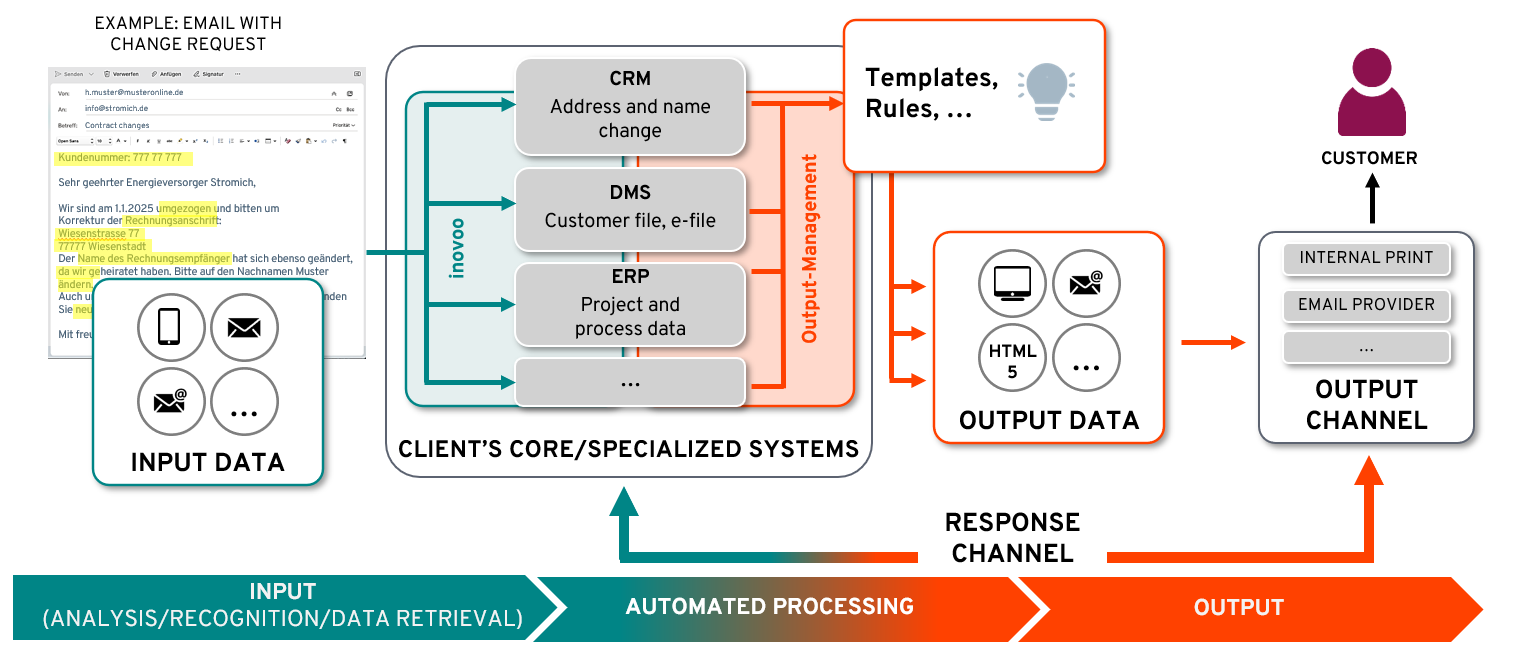
Output Management und inovoo
With NOVO CxP, inovoo offers a flexible input management platform that allows you to optimally process and structure incoming information before passing it on to output management. Documents and messages from a wide variety of input channels are centrally processed, prepared, and made ready for output management. Where the data for output management is stored is fully under your control – thanks to numerous interfaces, you can seamlessly connect NOVO CxP to any system.
Conclusion: Efficient communication through modern input and output management
Output management ensures that information reaches its destination reliably, consistently, and efficiently. Rather than relying on fragmented individual solutions, a centralized approach enables clear control over the entire output process—across systems, channels, and departments. Companies benefit from reduced costs, improved quality, and significantly enhanced communication.
When combined with input management, output management enables true end-to-end processes, making it an essential component of digital transformation.
