Intelligent Data Processing – a long-term strategy for success
For decades, it was mainly specialist departments and IT teams that were involved in Intelligent Data Processing (IDP, also known as Intelligent Document Processing). The focus was on digitizing documents and reading and structuring data, along with the necessary technologies, such as OCR (optical character recognition). Although data extraction via OCR became increasingly accurate over time, a real breakthrough only came with artificial intelligence. Thanks to AI, data extraction can be carried out much more quickly and effectively, even with complex documents. Now, it's not just administrators and IT experts who are interested in this, but also management. IDP offers not only operational but also enormous strategic opportunities, especially in today's challenging business environment. In this blog article, you can learn about the economic developments behind this and how it is changing the role of IDP in companies.
Go straight to:
Changes that make companies successful
At first glance, Intelligent Data Processing is primarily a technical tool that reduces the amount of work involved in processing communication. Automated extraction of data from documents means that employees no longer have to spend hours searching and typing out information, allowing them to use their time more productively. Many companies see this as an opportunity to address staff shortages and better allocate existing resources. Such effects are highly relevant in times of skilled labor shortages and economic pressure – but this way of thinking underestimates the true potential of automated communication processes.
To understand how seemingly isolated improvements actually affect the entire company, let us take a look at an example from production management: Toyota's Kanban method, which was first implemented in automotive production. This revolutionary control method was not based on complex technology, but on simple paper cards that optimize the supply of materials. Initially, this made the production process at Toyota significantly more efficient, which saved costs. However, Kanban also improved delivery readiness and had a positive impact on the amount of tied-up capital. That is why this method became a long-term, strategic success factor for Toyota, Volvo, Bosch, and many other companies — even though it was based on a simple, isolated change.
Automation as a strategic decision
So what does this success story mean for companies that want to strengthen their entire business through optimized communication rather than production processes? Specifically, this leads to the following insight:
Local improvements have company-wide impact.
What initially appears to be a mere operational optimization — such as the more efficient processing of invoices, forms, or emails — can have an impact on the entire company and its long-term success. When information from documents is always available reliably and quickly, downstream process steps can start earlier. In addition, bottlenecks can be easily identified or even avoided altogether. The entire process becomes more transparent, faster, and easier to control. Valuable data on frequent customer concerns, processing times, and other key figures can thus be provided automatically, enabling informed strategic decisions.
This creates a domino effect in which an optimized process increases business success across departments.

Intelligent Data Processing (IDP) is a technology that automatically extracts data from documents, processes it, and integrates it into digital business processes. This has many advantages for companies:
- Accelerated processes – documents and data reach their destination faster, reducing processing times
- Workload reduction & cost efficiency – automated processes reduce the workload on staff and minimize error costs
- Compliance and security – through greater transparency and audit-proof archiving
- Better customer experience – thanks to short waiting times and high processing quality
Why IDP is more relevant than ever
Companies in Europe and around the world are currently facing a combination of challenges and new technological opportunities that has never been seen before. For example, in Germany, some of the most prevalent issues are low order volumes, the investment climate, the increasing cost of complex administrative tasks, and the continuing shortage of skilled workers (source: IT-BUSINESS / Synaxon Servicepreisspiegel). In addition, there is a general sense of pessimism due to trends such as increased global competitive pressure, bureaucracy, and energy prices. To absorb macroeconomic factors and geopolitical tensions, companies must invest in digitalization and transformation, according to Achim Wenning, head of a study by management consultancy Horváth (source: WirtschaftsWoche).
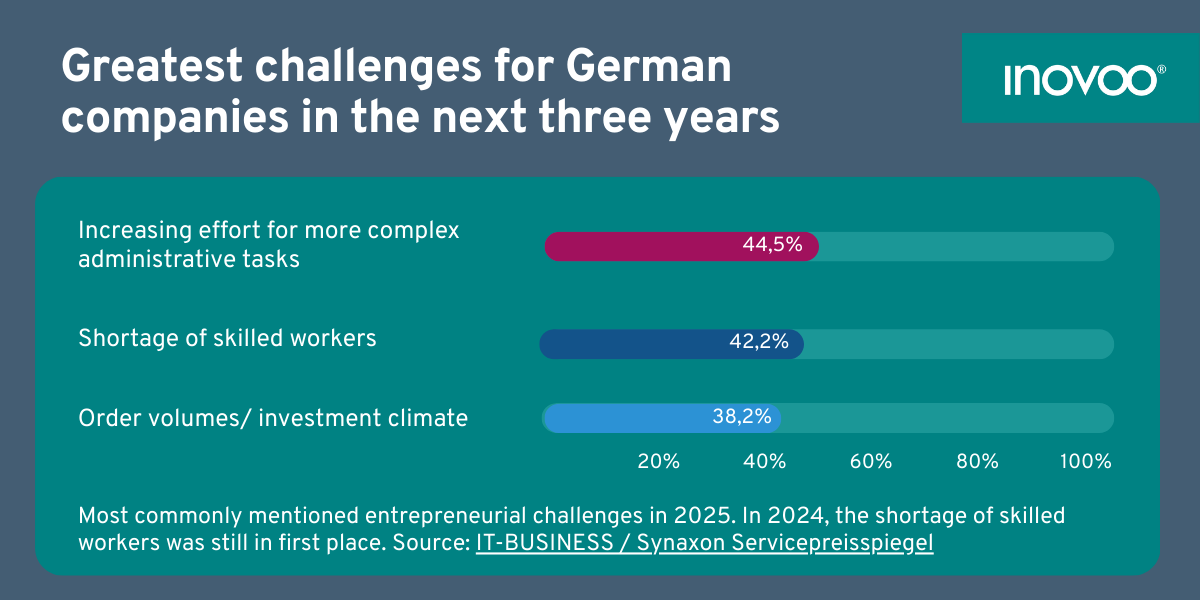
These challenges mean that the urgency to act in the area of digital transformation is particularly high. At the same time, completely new opportunities for the digitization and automation of processes are currently opening up. Until a few years ago, there were technical challenges that limited the strategic impact of intelligent process automation. With artificial intelligence, even complex processes that previously relied heavily on human intervention, for example due to forms with frequently changing fields or different layouts, can now be automated. These new technical possibilities mean that much more processes can be fully automated with little effort. The resulting improvements have an impact on the entire company and can even serve as a model for the use of AI in other areas.
Develop your ideal IDP strategy in three steps
1. Define goals:
As with any transformation project, clear goals are needed to provide guidance during planning, software selection, and implementation. In an IDP project, there can be different types of goals:
- Process-related goals – e.g. reducing the processing time for document X by 80% or achieving an automated processing rate of 75% for document Y
- Department-related goals – e.g. staff should spend no more than 5% of their working time responding to emails, so that they have more time for important tasks
- Strategic goals – e.g. improving customer service in order to become the industry leader in this area
The specific goals can vary greatly depending on the industry, company size, and existing software solutions.
2. Analyze processes:
The most important component of a successful IDP project is a detailed analysis of the company's processes. It helps to ask the following questions:
- What impact do the individual processes have on the company?
- How can automation contribute to the defined goals
- What types of documents are currently being processed and which ones should be processed in the future?
- Where are there bottlenecks in processing? Are there manual intermediate steps that could be automated?
- What security or compliance requirements are there? (e.g., data protection, AI use, cloud operation)
3. Define KPIs:
The final step before implementation is to define suitable key performance indicators for measuring the success of the project. These are based on the previously defined goals and the process analysis. Typical KPIs for an IDP project can be divided into several categories:
- Efficiency metrics – e.g. average processing time per document, throughput per hour/day, proportion of fully automated documents
- Quality metrics – e.g. extraction accuracy, error rate, or post-processing rate
- Cost metrics – e.g. cost per document before and after implementation, labor cost savings, project ROI
- Strategic metrics – e.g. reduced response times for customer inquiries, customer satisfaction, or faster decision cycles
- Compliance metrics – adherence to regulatory requirements
Finding the right software for your company
Once you have a clear strategy in place, you need to find a software provider that fits your business and your goals. Modern IDP software should be flexible — not only for managing processes, but also in terms of the technologies used and the operating model (e.g., in the cloud or in your own data center).
Many companies rely on inovoo solutions, which are based on over 20 years of experience and the latest technologies. With the flexible low-code platform NOVO CxP, you can automate any process, regardless of whether you receive documents by email, post, online portals, or other channels. The data from the documents is intelligently processed and structured. This allows it to be transferred directly to the target systems. The information ends up exactly where it is needed, and further automated steps can start immediately.
Your processes are rather complex? NOVO AI Studio enables you to flexibly use AI that helps you achieve your goals and grow your business, even with the most challenging document and process types. With many templates for typical document processes, you can get started right away and unleash the power of AI in your business.
For a complete overview of important process metrics, inovoo offers NOVO BI Board, which provides real-time information about current processing and valuable insights into your processes. NOVO BI Board provides important insights for optimal operational management and enables you to identify and eliminate potential bottlenecks. This helps you to better understand the impact of your processes and make informed strategic decisions – so that your document processes remain a long-term success factor.
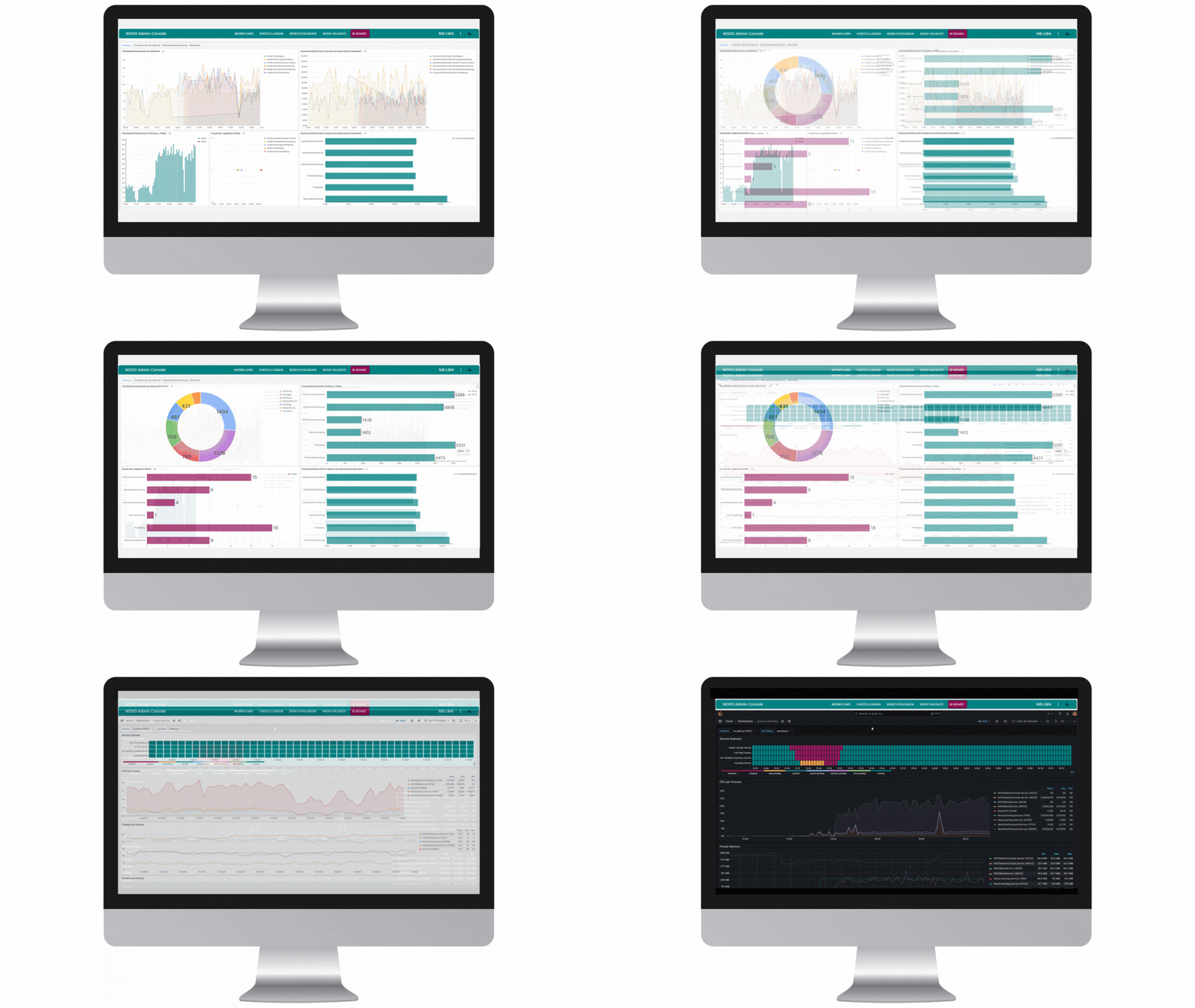
NOVO BI Board: The business intelligence tool by inovoo
Conclusion: An efficiency tool became a success factor
Intelligent Data Processing has evolved from a purely operational efficiency tool to a decisive key to business success. Through the use of AI, even complex document processes can now be automated, accelerated, and made more transparent — with a noticeable impact on efficiency, quality, and customer satisfaction. At the same time, challenges such as skills shortages and macroeconomic factors are increasing the need for action. Companies that define clear goals, systematically analyze their processes, and measure success can exploit the full potential of IDP and achieve sustainable competitive advantages. The key is to see the transformation as a strategic initiative that benefits the entire company.