Secure AI Adoption: A 3-Step Guide to Compliance and Efficiency
The “experimentation” phase is over – this is shown by a recent study by Wharton Business School regarding the use of AI in the company context. AI is increasingly adding value to companies, which is increasing competitive pressure —especially for those who are still hesitant to adopt it. Many companies, especially in Europe, have concerns about data security and compliance. These concerns are justified, as the incorrect use of AI can endanger customer or even company data and also carries legal risks. However, this should not prevent companies from utilizing the potential of AI. With the right strategy and software, AI can be used to accelerate processes while ensuring complete data security. Read this blog article to find out exactly how that works.
Go straight to:
A three-step guide to the right AI strategy
The path to safe and efficient AI deployment begins with a clear strategy. As with other IT projects, careful planning is essential to ensure the project's feasibility and cost-effectiveness in advance. This structured three-step approach helps you to seize opportunities while minimizing risks.
1. What do I need? – Scoping and goal definition
Before deciding on an AI solution, you need to define your specific requirements. You should ask yourself the following questions:
- Which business processes do you want to optimize with AI? (e.g., customer service, document processing, data analysis)
- What specific goals do you want to achieve? (e.g., time savings of at least 50%, reduction in error rate)
- Which AI solutions can be used to achieve these goals?
- What does the existing system landscape look like? Should the AI solution integrate with it or replace legacy systems?
- Which communication channels or target systems should the solution be connected to?
- Who are the end users of the AI solution? Will training be required?
Once you have answers to all these questions, you should have a clear picture of your ideal AI solution. Next, clarify which regulations and data protection requirements need to be taken into account.
2. What data protection and security standards do I have to meet?
To avoid making your AI project a compliance risk, carefully analyze which regulations apply to your industry and company. The key question is: What data is being processed, where, and by whom? This is especially important for sensitive customer data, such as in the healthcare industry. In general, there are three types of regulations to consider:
-
EU Legislation: The General Data Protection Regulation (GDPR) establishes the framework for handling personal data within the EU. Every company that processes data must comply with the GDPR.
Another important EU regulation is the AI Act, which classifies AI applications into risk categories. The AI Act generally plays a minor role in the processing of incoming documents and the automation of business processes using AI. -
National & industry-specific regulations: Industries such as insurance or healthcare are often subject to strict regulations.
-
Internal compliance requirements: Always be aware of your own company guidelines on data security and the use of AI.

3. Which solution and which hosting model are most suitable?
Based on your requirements and compliance specifications, you can now select the appropriate hosting model and the right software. Be aware that not all solutions will necessarily support your desired hosting model. These are the most common options:
-
Cloud (“public cloud”): Using Large Language Models (LLMs) in the cloud from providers such as Microsoft Azure offers high scalability, low start-up costs and the possibility to start quickly. However, your data will be processed on servers belonging to external providers (often US companies). In the case of sensitive data, this can lead to GDPR concerns and problems with the Cloud Act.
-
Local (on-premises): With locally hosted LLMs (e.g., Llama 4, Mistral), you maintain complete control over your data and infrastructure. Maximum data security and compliance are ensured. However, you should take into account the associated hardware and maintenance costs, as well as the administrative effort. Additionally, processing usually takes more time. Nevertheless, local LLMs are a sensible option for use cases where speed is not a priority.
-
Hybrid: This option combines the best of both worlds. Non-sensitive data is processed in the cloud, while sensitive data remains local. However, this creates additional complexity in integrating and managing both systems.
- Local LLM hosted in an EU cloud: With this approach, you benefit from the flexibility of the cloud; however, data processing takes place in the EU and is therefore subject to the GDPR. It is crucial that the cloud provider ensures customer data is fully isolated.
Secure AI by inovoo – NOVO AI Studio
To make your AI project a success, you need a solution that combines data protection, security, and performance. NOVO AI Studio offers exactly that: it uses the power of AI to process documents and data from a wide variety of areas and input channels in record time. Thanks to ready-made AI process templates, you can automate many use cases immediately or create your own customized process. You can design the workflows using drag & drop and customize them yourself at any time, even without special AI expertise.
NOVO AI Studio is suitable for any type of data protection requirements, as the LLMs used can be selected flexibly. Whether in the cloud, locally, or a hybrid solution—you decide:
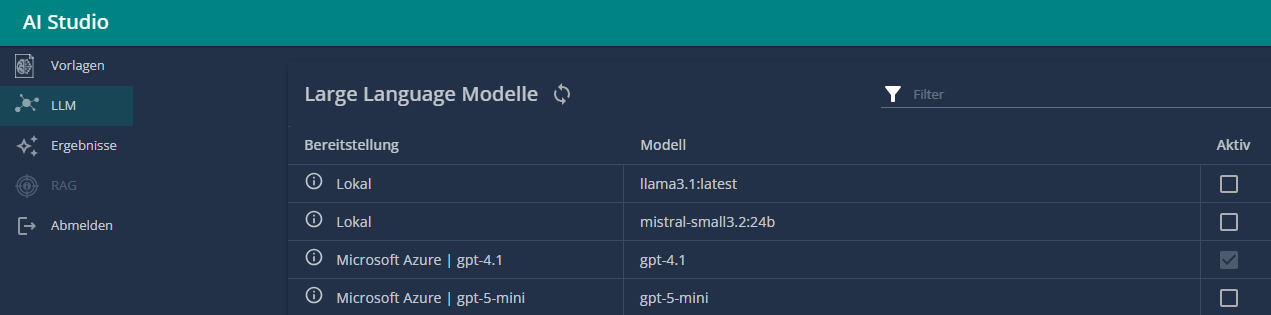
Selecting an LLM in NOVO AI Studio
Over 20 years of experience in data and document processing
For over 20 years, inovoo has been providing customers from various industries with powerful software that accelerates processes and automates document processing. The focus is always on the latest technologies and customer needs. inovoo's solutions lead to success – as confirmed by analysts such as Gartner and infosource. Discover our references now or learn more about NOVO AI Studio:
Conclusion: Get started with secure AI
An increasing number of companies are using AI to speed up their processes and boost customer satisfaction. Those who have hesitated in the past due to data protection concerns should develop an AI strategy that addresses this issue.
With flexible solutions such as NOVO AI Studio by inovoo, you can seamlessly integrate privacy-compliant AI into your existing processes. This will increase efficiency, reduce your team's workload, and give you a true competitive advantage.