What is Low-Code in Process Automation?
Low-code is an approach to developing applications and processes that requires very little traditional programming (“code”). Instead of writing extensive code, the focus is on using graphical interfaces, visual modeling, and predefined building blocks. Various modules, data flows, and integrations can be assembled and configured using drag-and-drop. Low-code platforms automatically implement these visually modeled processes in practice. In the area of process automation, low-code allows companies to focus on the actual process and its steps instead of technical details. This enables them to create and customize digital solutions much faster than with traditional software development.
Go straight to:
Why is Low-Code becoming increasingly important?
Companies want to digitize and automate routine processes as quickly and easily as possible. However, these processes often need to be adapted after a certain period of time, as input channels or document formats can change. At the same time, IT resources are scarce and development projects are often time-consuming and expensive.
Low-code platforms allow automation projects to be implemented quickly and flexibly, even with limited IT resources. Specialist departments can actively participate in workflow design or even create and adapt workflows themselves. This accelerates innovative projects and reduces dependence on software providers.

A low-code platform is software that allows you to create automated workflows and integrations for your business processes in a very visual way, e.g. using drag-and-drop. The platform handles the technical implementation in the background — such as executing processes or connecting systems. At the same time, it remains open to individual expansions if new components are required.
Which processes can I create using Low-Code?
Low-code is particularly suitable for modeling and automating business processes that can be mapped using standardized modules (e.g., text extraction from documents via OCR) and affect multiple systems or departments. Typical processes that can be efficiently implemented with low-code include:
- Customer service and support processes:
Service requests reach companies through various channels such as email, forms, or portals. Low-code can be used to model processes that capture, classify, prioritize, and automatically forward requests to the responsible teams or systems. - Incoming mail and communication processes:
Incoming information from letters, emails, or digital forms is centrally captured and transferred to structured processes. Low-code makes it possible to flexibly adapt these processes, for example, in the case of new document types or changed responsibilities. - Application and approval processes:
Whether it's membership applications, contract approvals, or public service processes: Low-code lets you create workflows that enable end-to-end digitization, covering everything from application submission and review to final decision and documentation. - Other integration and transfer processes:
Data often needs to be exchanged between different systems. With low-code, you can create processes that automatically transfer information to downstream systems such as ERP, CRM, or DMS.
How do Low-Code process automation platforms work?
Low-code platforms provide an environment in which you can visually design workflows. These are the four key characteristics:
- Visual modeling: Processes, rules, and data flows are visualized graphically
- Predefined modular components: Standard modules and functions such as validation or interfaces are provided and can be easily added to the process
- Expandability: If necessary, you can add additional, customized modules or integrations using code
- Centralized management: Monitoring and operation are performed via a shared platform
Benefits of Low-Code for companies
The use of low-code brings both technical and financial benefits:
- Faster implementation & flexibility: With low-code, new processes can be implemented much faster than with traditional development. In addition, you can adapt processes at any time later on, with little or no development effort. This allows you to implement new requirements faster and respond more flexibly to changes.
- Better collaboration between specialist departments and IT: Specialist departments can model and maintain processes themselves, as these are visualized in a way that is easy to understand. This allows requirements to be coordinated more clearly with IT, misunderstandings to be avoided and projects to be implemented more efficiently.
- Independence from software providers: With low-code, you are no longer dependent on expensive maintenance contracts and can manage your processes yourself, independently of software providers.
- Scalability and reusability: Once modeled, processes or components can be reused and expanded for other use cases. New processes can be built on existing models without starting from scratch.
- Lower error rate and higher quality: Standardized modules reduce manual intervention in the software and thus potential sources of error.
Low-Code enables End-to-End processes
Low-code platforms simplify the creation and maintenance of workflows that cover an entire business process. This makes the implementation of end-to-end processes much easier. With a wide range of standardized modules that are available at any time via a central platform, all necessary processing steps can run smoothly. Such platforms usually offer seamless integration options with systems such as output management, enabling the automation of entire communication cycles. In customer service, for example, this means that complete service cases, including any follow-up questions, can be processed automatically. This benefits not only you as a company, but above all your customers, whose requests you can process in no time at all. In our blog article on end-to-end processes, you can find out how this works in detail.
NOVO CxP: The Low-Code Platform by inovoo
With NOVO CxP, inovoo offers a powerful low-code platform that allows you to flexibly digitize and automate your processes. At the heart of the platform is the Workflow Design Studio, an intuitive workflow configuration tool. It allows you to design your own processes according to your specific requirements. This also means that you can easily connect your existing systems such as ERP, CRM, DMS, CCM, or other applications. With the numerous modules available, you can cover virtually any input process — regardless of document type, input channel, or data source. In addition, you can also incorporate the latest AI technology into your processes via the NOVO AI Studio. This allows you to flexibly integrate current cloud LLMs or locally hosted alternatives into your processes, tailored to your specific needs. This combination of different technologies means you are ready for any challenge and can achieve impressive automation rates even in complex processes.
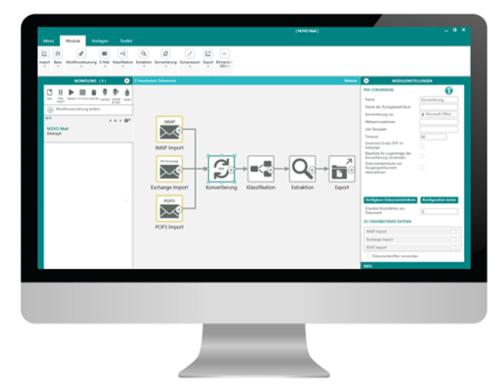
Process modeling in the Workflow Design Studio of NOVO CxP
Conclusion: Low-Code is the future of process automation
Low-code platforms enable companies to automate business processes flexibly and efficiently and to continuously adapt them. With the help of visual modeling, standardized modules, and easy integration, automation projects can be implemented even with limited IT resources. At the same time, low-code promotes collaboration between specialist departments and IT, increases process quality, and enables end-to-end processes that improve customer service in the long term. With modern solutions such as NOVO CxP and NOVO AI Studio, you benefit from both the advantages of the low-code approach and the power of modern AI technology.
