What is Process Automation?
Does your company also have time-consuming, repetitive tasks that take up too much of your staff's time? You are not alone: Complex processes that handle incoming data and documents are widespread today. Communication takes place across an increasing number of channels and often involves large amounts of diverse information. Manual processing consumes valuable resources and comes with a high risk of errors, especially when a single employee has to spend hours checking and entering large amounts of data into systems. The solution to this is process automation, in this context also known as business process automation (BPA). It transforms complex processes into digital and automated workflows, improving efficiency in the processing of communication.
Go straight to:
What exactly is Process Automation?
Process automation in companies is about relieving employees of monotonous routine tasks and having these tasks run automatically instead. For example, incoming emails no longer need to be read and sorted manually. Various technologies and software solutions, such as workflow management systems, are required to automate such processes. These are typical tasks that can be included in an automated process:
- Data extraction: reading relevant data from documents (e.g., customer numbers, amounts, addresses)
- Classification: assigning documents and data to different categories (e.g., membership applications, invoices, specific forms)
- Data matching and validation: the data is checked or matched (e.g., does the customer number exist in the system? Does the IBAN have the correct number of digits?)
Another important factor is connecting the input channels or data sources. Only if the system can automatically retrieve the documents and data, for example from email inboxes, can the entire process be automated. Equally important is the integration of the target systems, where the processed data is ultimately stored and used.
Which processes can be automated?
What types of processes can be automated in a particular company depends on the industry and the company's own communication structure. Some processes, such as customer service via email, exist in almost every company. Once a certain volume of incoming emails is reached, automated processing almost always makes sense. However, there are also industry-specific or company-specific processes that can be very complex. Until a few years ago, such processes were difficult to automate. The effort required to develop a specialized solution was simply too high. Thanks to flexible platform solutions and AI technology, companies can now automate more processes than ever before - and they can do so in a very short time. Here are some examples of processes that are generally easy to automate:
-
Customer service: Service centers receive inquiries through an increasing number of channels, as customers have different preferences. This makes it difficult for service agents to keep track of everything. The solution is a platform that automatically sorts inquiries from different channels according to their content and forwards them to the right contact person.
-
Incoming forms: Many organizations, for example different types of insurance companies, have standardized forms that are submitted thousands of times. For example, these could be forms for refunds on dental care. Automation is particularly beneficial here: High volumes can be processed quickly.
-
Incoming emails and mail: Many companies receive the majority of their service requests and forms via email and letters – but together with other communication. Process automation is essential to ensure that every customer receives a prompt response despite full mailboxes and scanning queues.
-
Invoices: Incoming invoices need to be read and also verified. This check is carried out according to clear rules (following EU or national legislation), but is still prone to errors when a large number of invoices are processed manually. That's why automated reading and verification are the ideal solution for high invoice volumes.

There are various options for creating an automated process, depending on the software used. To avoid relying on scarce IT resources, experts recommend using a low-code platform. This allows automation projects to be implemented quickly and flexibly. You can find out exactly how this works in our article on Low-Code:
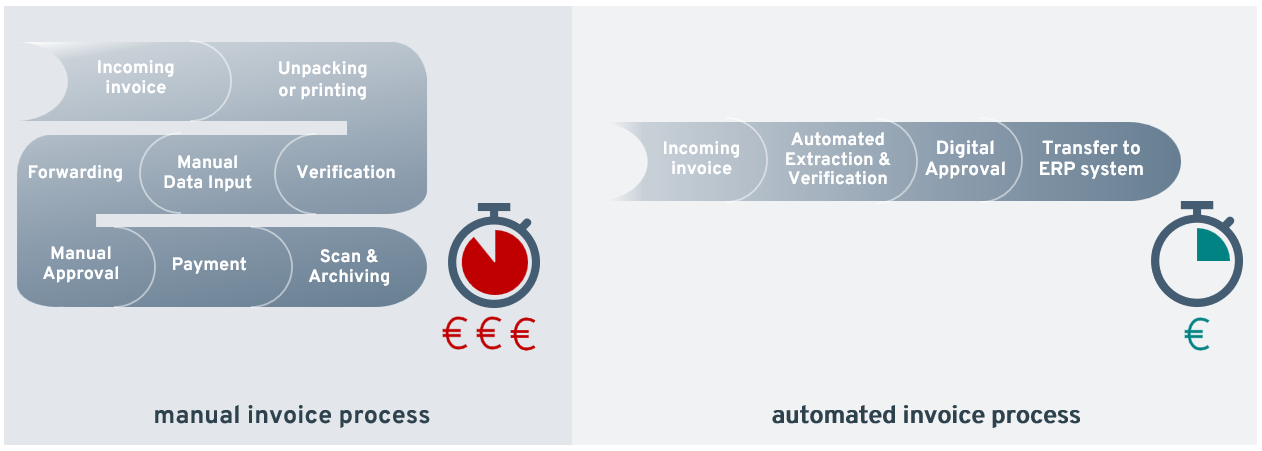
One of many processes that automation makes much more efficient: invoice processing
The role of AI in Process Automation
For several years now, artificial intelligence, particularly in the form of large language models (LLMs), has fundamentally transformed business process automation. With generative AI, it is now possible to automate processes that previously required human intervention. For example, generative AI can automatically evaluate a wide variety of document types – even those that were difficult to process with traditional OCR or rule-based systems, such as forms with frequently changing fields or varying layouts. Companies that make smart use of AI's potential can reduce manual effort in document processing to a minimum. However, only a few organizations have reached this level so far.
As powerful as AI is, it only unleashes its full potential when it is seamlessly integrated into existing processes. In practice, existing solutions are often supplemented by additional AI tools. Such isolated solutions increase overall maintenance costs and create additional barriers between systems. This can ultimately result in AI delivering fewer benefits than expected.
When automating processes with AI, it's better to rely on platforms or input management systems that come with modern AI features already built in. This lets you combine process management and AI within one unified system. It cuts down on interface issues, makes administration easier, and keeps processes stable, scalable, and future-proof.
Process Automation by inovoo
Inovoo has many years of expertise in automating business processes for companies and the public sector. The low-code platform NOVO CxP can integrate various input channels (e.g., email, letters, online portals) and technologies, allowing you to automate virtually any process. Thanks to flexible interfaces, the data obtained ends up exactly where it is needed: directly in your target systems. NOVO CxP connects seamlessly with NOVO AI Studio, inovoo's AI process solution. Even hard-to-read documents or complex layouts are processed reliably. Depending on your requirements and data protection needs, you can choose from a variety of LLMs in NOVO AI Studio – hosted in the cloud or locally.
Conclusion: Process Automation as a success factor
Process automation is a key success factor in industries with high communication volumes, as it saves time and money. Modern technologies enable companies to perform repetitive tasks efficiently and reliably – at any scale. Through the targeted use of AI, even complex processes that were previously challenging can now be digitized and automated. With software solutions such as NOVO CxP and NOVO AI Studio from inovoo, you can achieve these goals and start benefiting from the results in no time.
